

 Italiano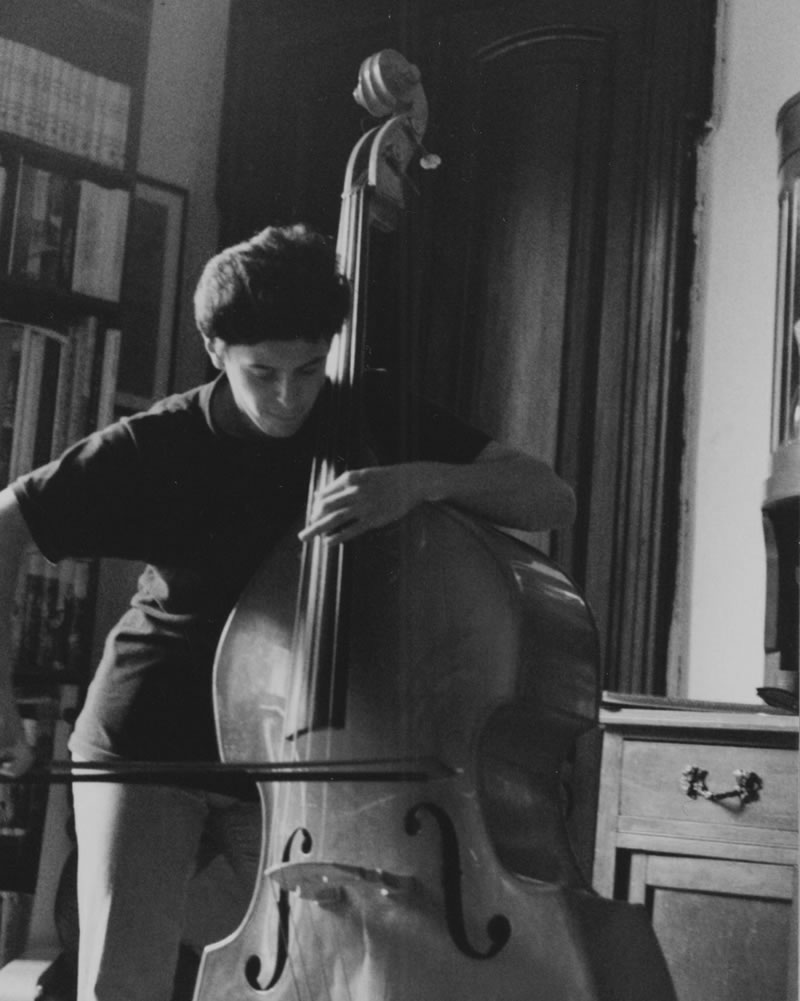
Conductor, composer, double bass player and ‘pianist when necessary’ as he loved to refer to himself, Ezio Bosso was born in Turin on September 13, 1971, into a working-class family.
Right from the start he showed the desire and ability to overcome limitations that went on to define his long career. He made his debut as a soloist aged 16 in Lyon, France. He then studied double bass, composition and conducting at the Vienna Academy, performing with several European orchestras including Chamber Orchestra of Europe, Festival Strings Lüzern, Deutsche Kammer-Virtuosen.
Eclecticism, versatility and generosity are the hallmarks of his artistic career. Indeed, the list of collaborations with prestigious musical institutions and concert seasons where he featured as composer, performer, conductor or member of chamber ensembles is testament to this: Royal Festival Hall of London, Sydney Opera House, Palacio de Bellas Artes di Mexico City, Teatro Colón di Buenos Aires, Carnegie Hall NYC, Teatro Regio of Torino, Houston Symphony, Auditorium Parco della Musica of Roma, Teatro Comunale of Bologna, Perelada Festival, Teatro La fenice of Venezia, Teatro Carlo Felice di Genova, Lac Lugano, KKL Lüzern.
Winner of significant awards, such as Green Room Award in Australia (so far he is the only non-Australian to receive the accolade) or Syracuse New York Award in the USA, Boss’s music has been commissioned and indeed is still in use by the most important world opera institutions such as Wiener Stadtoper, Royal Opera House, Sidney Dance Company, New York City Ballet, Theatre du Chatelet, San Francisco Ballet o Bolsoj Theater, by prestigious choreographers such as Christopher Wheeldon, Edwaard Lliang and Rafael Bonchela, and by famous theatre directors such as James Thierrée or film directors such as Gabriele Salvatores, for whom he composed the soundtracks of “I’m not scared” (2003), “Quo Vadis Baby?” (2005) and “The Invisible Boy” (2014).
In 2005, an accident to his left hand pushed him to focus mainly on conducting and composition. In the same year he founded Buxusconsort with musicians from the Quartetto D’Archi di Torino, the former Borciani Quartet and young European musicians, the Buxusconsort.
Also in 2005, whilst in New York for the recording of his quartet for saxophones and the soundtrack of the film “Quo Vadis Baby?” he met Philip Glass who invited him to his studios to collaborate with world-renowned producers and technicians.

In the following years, his desire to explore different forms of musical and artistic expression, as well as his well-known obsession with understanding the various modes of expression peculiar to the human being, led him to collaborate with a wide range of musicians and artists. These include: Pino Daniele, Billy Corgan (Smashing Pumpkins), Gustavo Beytelmann (Gotan Project), the “guru” of Club Culture Alessio Bertallot and the painter Jean Michelle Folon. Social commitment becomes a constant feature of his work and over the years he composed for associations such Libera, Unicef and Progetto Sorriso nel Mondo.
Together with the Neapolitan rapper Lucariello and Roberto Saviano he created “Cappotto di Legno”, a world first in music, fusing rap in dialect and “classical” composition systems, which later became a video clip financed and produced by MTV Italia, as part of the “No Mafie” project. Ezio and his Buxusconsort opened the l’MTV day 2008 in Genova, in front of an audience of 50,000 people, with millions more watching from home.
In 2009, he was commissioned by the Festival Suoni delle Dolomiti to produce his second symphony, entitled “Under The Tree’s Voices”, dedicated to the resonant firs of Val di Fiemme.
After its first performance at the Suoni delle Dolimiti Festival in July 2010, the local community dedicated a tree in the Musical Forest to him, an honour reserved for leading musicians on the world scene.
In 2010, for the closing of the symphonic season at the Teatro Regio in Turin, he conducted the world premiere of his First Symphony “Oceans”: a huge success with a full house, standing ovation and fifteen minutes of applause. Also in 2010, he conducted the Italian premiere of “Icarus on The Edge of time”, an event organised by Philip Glass and Bryan Green at Teatro Carlo Felice in Genova. The orchestra was the Filarmonica ‘900, for which he acted as “consultant for special projects”, a particular affection and esteem linking the two.
In March 2011, he was appointed Principal Conductor and Artistic Director of the English Orchestra The London Strings.
In 2015, he was chosen by the Alma Mater University of Bologna to write and conduct his Fourth Symphony, dedicated to the Magna Carta of European Universities and constituting the first official anthem of this prestigious institution.

By 2016, Bosso was one of the most active and most successful artists in Italy. His first solo piano album, “The 12th Room”, was awarded the Gold Record in Italy selling over 50.000 copies and attracting over 100,000 spectators when toured. Moreover, it received unanimous acclaim from critics and consistently warm enthusiasm including as part of cultural programmes designed specifically to involve the viewer in a cognitive and emotional journey through the height of musical expression. Chopin, Bach and John Cage were experienced by the public – including many for whom these concerts represented their first such listening experience – with a spontaneous interest. The audience was captivated by the virtuosity, poetic and ironic narration that characterises his performances. A clear vocation to spread his love of music permeates the ethical and intellectual foundations of Bosso the man; a history which is also marked by his friendship with one of the absolute masters of twentieth-century interpretation, Claudio Abbado, Claudio Abbado, to whom he was linked by a profound mutual esteem and affection.
His strong cultural but also social commitment finds its expression in his work for Palazzo Barolo, one of the great baroque residences of Turin, which is today a lively centre for cultural dissemination and seat of the Opera Pia Giulia di Barolo.
This latter is also very active in combatting social and physical inequalities together with the 14 association, for which Ezio was a testimonial. Indeed, Mozart14 is one of Abbado’s social legacies, carried forward with rare commitment by his daughter Alessandra Abbado
In October 2016, following a 6-year absence from the podium, Ezio Bosso returned to one of the cornerstones of his musical vision, conducting, with a sensational and highly anticipated debut at the Teatro La Fenice in Venezia. The demanding programme featured Bach’s third Brandenburg concert, the Mendelssohn’s “Italian” symphony no. 4 and Bosso’s own virtuosic and fascinating violin concerto, “Esoconcerto” with Sergej Krylov as tightrope-walking soloist.
A recording of this triumphal concert was released by Sony Classical (The Venice Concert, 2017) who subsequently re-released Bosso’s 2004-2011 discography and for whom he also recorded “Stradivari Chamber Orchestra” (2018) and “Roots” (2018).

Professionally, Bosso appeared over the last few years on the podiums of many of the most important orchestras in Europe: notably, for the Orchestra del Teatro Comunale di Bologna, where he was Principal Guest Conductor, triumphantly conducting both in the city’s concert hall and in Piazza Maggiore in front of over 10,000 people for the G7 Environment Opening Act concert named by the Live Award in Lisbon as the best European musical event of the year; for the Georgian State Opera and Ballet where he conducted an operatic gala alongside singing divas Nino Surguladze and Carmen Giannatasio, which saw over seven standing ovations and was followed online by more than 4 million people from all over the world; and also for London Symphony Orchestra, Orchestra del Teatro Regio in Turin, Filarmonica ‘900, the Orchestra of the National Academy of Santa Cecilia, the Orchestra of the San Carlo Theatre, the Sicilian Symphony Orchestra, the Mantua Chamber Orchestra, the thuanian Chamber Orchestra with the soloist Sergej Krylov, the Toscanini Philharmonic Orchestra of Parma, the Philharmonic Orchestra of the Verdi Theater of Salerno in the Archaeological Park of Paestum with over 8,600 spectators and the Italian Youth Orchestra of Fiesole with Anna Tifu for the 2018 edition of the national music festival.
On 20 January 2019, he conducted the Mozart14 Association event“Grazie Claudio!”, in Bologna, released in 2020 by Sony Classical as a tribute to Claudio Abbado five years after his death. This project brought together an orchestra of 50 musicians from the very best European ensembles who had all worked alongside Abbado, among whom are found names such as Keith Pascoe, Etienne Abelin, Robert Kendall, Jorg Winkler and Luca Franzetti.
Also in 2019, two Rai3 event nights took place, under the title “Che Storia è la Musica”, which saw him take on the triple role of composer, conductor and leader of the orchestra. These quite literally revolutionised the history of musical TV broadcast, with average ratings of over a million, definitively confirming his central role in the classical panorama. As if that wasn’t enough, this position was further confirmed by the sensational sell-out of over 14.000 tickets for his debut in Arena di Verona on 11 August 2019, with Carmina Burana.
On 24 giugno 2019 he he officially received an honorary citizenship of Rome, “in recognition of artistic excellence as an internationally renowned Italian composer and conductor, for his commitment to the city of Rome, and for having affirmed worldwide the universal value of music as an expression of the highest constitutionally recognized principles of equality and social dignity”. This recognition joins further honorary citizenships previously bestowed on him by the municipalities of Gualtieri (RE), Acireale (CT) e Busseto (PR).
Ezio Bosso died at the age of 48 in his home in Bologna, on May 14, 2020.
